
I. A Dual Personality on the Red Carpet
On May 4, 2026, Alex Consani appeared twice on the steps of the Metropolitan Museum of Art.
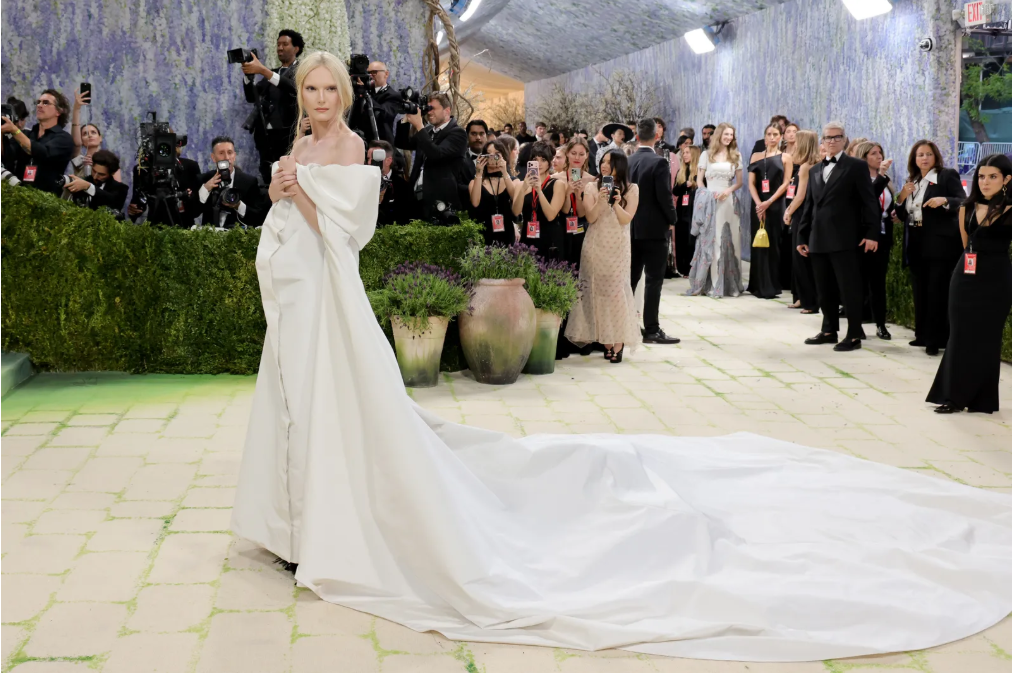
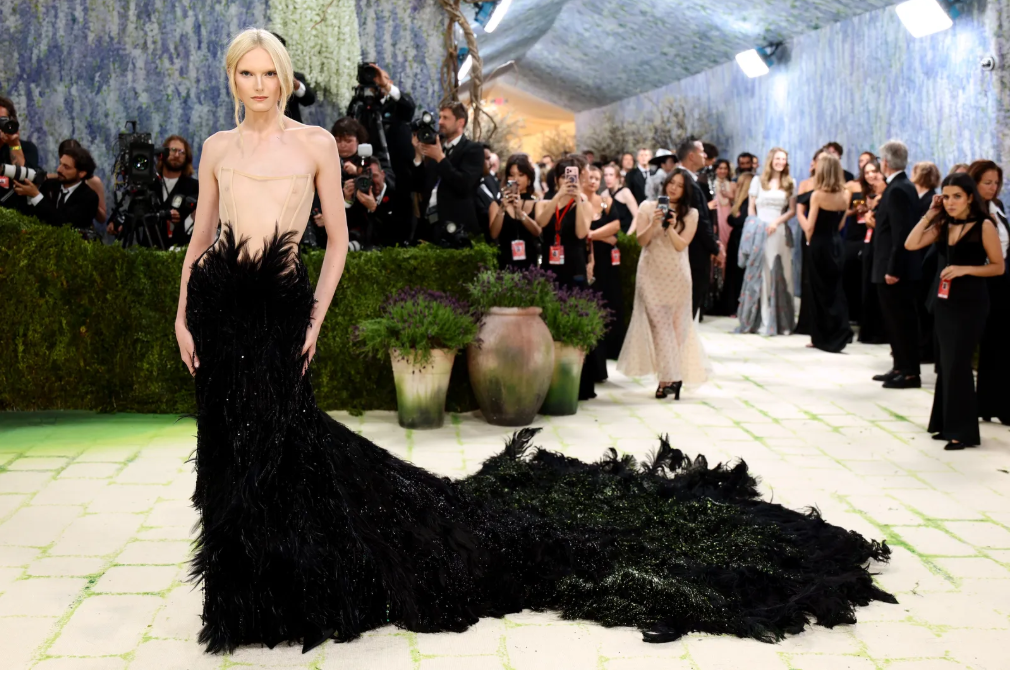
First, she wore a white taffeta robe, the fabric cascading down her shoulders like a snowfield. Second—just minutes later—the white robe vanished, replaced by a nearly transparent nude bodice and a long skirt woven from black feathers, its train trailing like a black swamp on the steps.
This double appearance was not accidental, but designed. Consani and her styling team—along with Gucci’s creative director Demna—carefully orchestrated a metamorphosis: from white to black, from concealment to exposure, from classical to contemporary. The audience was invited to witness the birth of a myth, or more accurately, a reinterpretation of a myth.
But a question remains: whose metamorphosis is this, really?
II. The Ghost of Botticelli
Consani’s design was inspired by Sandro Botticelli’s Primavera, a Renaissance masterpiece created around 1480. In the painting, Zephyrus, the god of the west wind, abducts Chloris, the goddess of flowers, who transforms into Flora, the goddess of spring, the moment she is touched.
Demna chose this specific narrative fragment—not Venus, not the Three Graces, but the moment when violence and transformation intertwine. This is intriguing. In Botticelli’s original painting, Chloris’s expression is between terror and acceptance; her body is undergoing an involuntary transformation. Demna places Consani in the same narrative position: a female body shaped by external forces, undergoing metamorphosis.
“We exchanged some reference images, talked about the feeling we wanted, and then he already had an idea,” Consani recalled in an interview with Vogue. “During his debut fitting, we talked about what I wanted, and he was very happy to make it happen.”
Note the wording here: “He already had the idea”—Demna’s idea preceded Consani’s involvement. “He was very happy to make it happen”—was it Consani’s wish being fulfilled, or Demna’s vision of Consani?
III. Armor and Performance
Consani’s description of the dress is full of dramatic metaphors. She said wearing it was “like putting on armor, making you better.” She said she “instantly became another person—I felt like Natalie Portman, a bit like Tilda Swinton…I felt it gave me an actress’s energy.”
These statements reveal an interesting tension. Armor is usually protective and defensive, but Consani’s “armor” makes her more exposed and vulnerable. The nude bodice is almost transparent, and the feather skirt, while gorgeous, offers no cover. It’s an inverted armor—not a defense against the outside world, but an invitation to its gaze.
“Demna gave girls the opportunity to express themselves,” Consani said. But the concept of “self-expression” always needs to be examined in the context of fashion. When a designer styles a model, whose self is it? The wearer’s, or the designer’s? When Consani says, “I feel like Natalie Portman,” is she expressing her own identity, or playing an assigned role?
IV. The Weight of History
Consani’s second Met Gala appearance carried a weightier significance than her personal life. She was the first transgender woman in Met Gala history to co-chair the host committee. “This is a very special moment,” she said, “as the first transgender woman to co-host the Met Gala. I am incredibly grateful to be a part of it and hope to set direction for the discourse on expression and the body.”
This statement was both sincere and strategic. Under the theme of “Fashion is Art,” Consani’s body—as a “worn work of art”—was placed in the sacred space of the museum. Her transgender identity was not the background, but part of the work. The transformative narrative of the feather dress resonates with her own life narrative: a shift from one state to another, a process from concealment to exposure.
But museumification always comes with risk. When a body is displayed as a work of art, it is simultaneously objectified. Consani’s appearance on the steps is both a declaration of empowerment and an object of contemplation. This duality cannot be eliminated, only acknowledged.
V. Last Year and This Year: An Accelerating Trajectory
Consani first attended the Met Gala in 2025, just one year ago. She wore a deep V-neck Swarovski crystal-embellished suit dress, adorned with over 18,000 crystals. From crystals to feathers, from suits to corsets, her styling language has undergone a dramatic shift within twelve months.
This acceleration is not accidental. In December 2024, Consani was named Model of the Year at the British Fashion Awards, becoming the first transgender woman to receive the award. With millions of TikTok followers, her appearance in Charli XCX’s “360” music video propelled her beyond the boundaries of the fashion world. She’s transitioning from a “model” to a “cultural figure”—someone who needs to “perform” on the red carpet, not just “display.”
Host committee status at the Met Gala accelerated this shift. From invited guest to co-organizer, Consani’s position underwent a qualitative change. She was no longer just wearing someone else’s designs; she began to participate in shaping the night’s discourse.
VI. The Politics of Feathers
Consani’s feathered gown required four people to carry the train. This fact in itself is noteworthy. At the Met Gala group photo shoot on Instagram, Vogue reported that Consani’s “massive amount of black feathers” required “a team of four” to assist her moving between rooms.
This reliance on labor reveals the implicit economic structure of high fashion. The opulence of a gown is always built upon the labor of a group of unseen workers. Stylist, tailor, porter, photographer—Consani’s solitary appearance on the red carpet overshadowed the collective effort that underpinned the moment.
Feathers, as a material, also have their own history. In fashion history, feathers are often associated with luxury, exoticism, and—ironically—fragility. They are beautiful, but easily damaged; they are eye-catching, but difficult to maintain. Consani’s feather dress, like all haute couture, is a manifesto of “unsustainability”—not in an environmental sense, but in an existential sense. This garment can only be worn once, exists only for this particular night, and then is archived or dismantled.
VII. After the Metamorphosis
Consani completed her metamorphosis on the steps: from white to black, from concealment to exposure, from classical to contemporary. And then?
In Botticelli’s Primavera, after Chloris transforms into Flora, the story doesn’t end. Flora stands in the center of the painting, scattering flowers, becoming the embodiment of spring. But her expression was calm, almost indifferent—as if the metamorphosis had exhausted all her emotions.
Consani’s expression on the red carpet was captured in the photos as the same calm. It wasn’t excitement, nor nervousness, but a trained, professional composure. This composure itself was a performance—a declaration of “I’m used to being watched.”
After the metamorphosis, the new identity needs to be inhabited. For Consani, the 2026 Met Gala is not the end, but a new beginning. From model to host committee member, from the viewed to the participant in the discourse, her metamorphosis continues.
And that feather dress—the one that required four people to carry, inspired by a 500-year-old painting, and which stayed on the red carpet for less than thirty minutes—will become a footnote in this metamorphosis. Not the most important part, but indispensable.