
I. The Gray Ghost on the Metropolitan Museum Steps
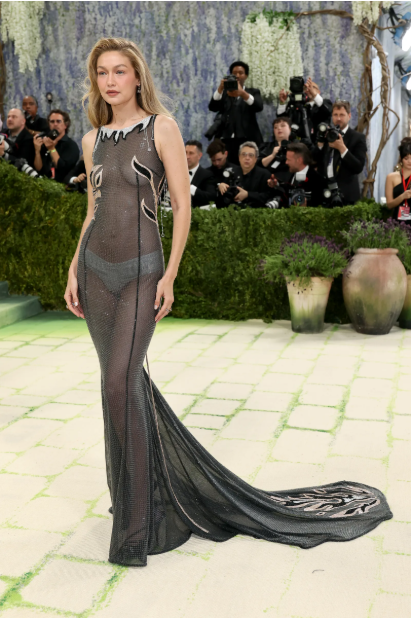
May 4, 2026, New York. Gigi Hadid appeared on the steps of the Metropolitan Museum of Art.
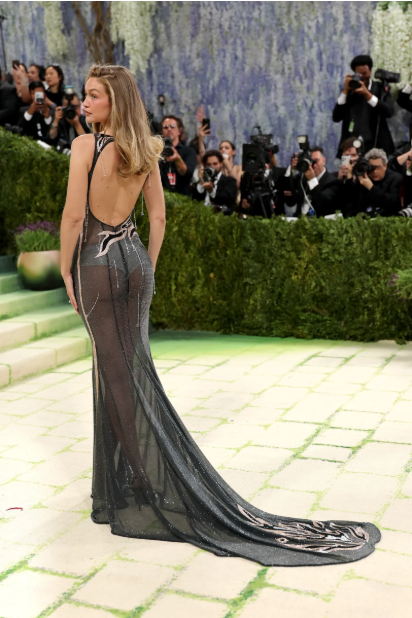
She wore an almost transparent gray gown, her body partially obscured by the sheer fabric. Silver and black flame patterns spread from her torso, converging into a blazing inferno at the hem. Diamonds sparkled along her back and shoulders like a galaxy. She held a bouquet of flowers, not as decoration, but as a gift—for the fans waiting on either side of the steps.
This was her eleventh Met Gala. For many, that number signifies familiarity, routine, playing it safe. But Hadid’s dress tonight, 48 hours earlier, was just a pile of scattered fabric and a stack of sketches.
II. The Initial Plan: A Tribute to 2011
Things shouldn’t have been this way.
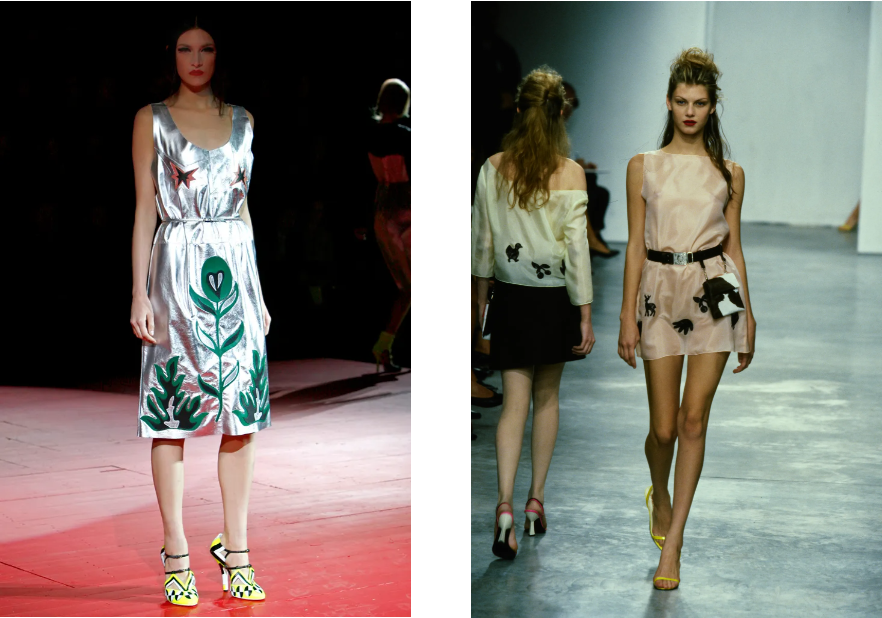
A few months earlier, Hadid and the Miu Miu design team sat down to discuss a completely different gown. The inspiration came from the brand’s Spring 2011 collection—the floral and flame embroidery, the intricate patchwork. Hadid was captivated by that collection, “especially the combination of flowers and flame embroidery,” she later recalled, “that celebratory, almost excessive glamour.”
The design team began working. Sketches were completed. Fabrics were chosen. Everything seemed to be going according to plan.
Then, a few days before the Met Gala, Hadid stood in the fitting room, watching the patchwork embroidery being attached to her body. The flames and flowers in the sketches were perfect on two-dimensional paper. But when they were transferred to the three-dimensional human form, something was missing. “The way the patchwork looked on my body wasn’t quite the same as when it was drawn,” she said. The flames were misdirected, the flowers were disproportionately dense, and the weight distribution of the entire gown made her feel constrained.
It was a familiar dilemma: the design succeeds on paper, but fails on the body.
III. Late Nights in the Archives: The Revelation of 1998
Hadid didn’t give up. She began rummaging through Miu Miu’s archives—collections from the past decades, runway photos sealed by time.
Then she saw it: the Spring 1998 collection. It was a series of looks based on transparent fabrics, where skin breathed through the sheer fabric, the body becoming part of the design, not a container for it. “I absolutely love the dialogue that skin and body create through the materials,” Hadid said.
At that moment, a new idea took shape: why not merge the two worlds? The transparent base of 1998, the flames and flowers of 2011. Not A or B, but A plus B.
She shared this idea with the design team. Time was tight—only two days left. But sometimes, deadlines aren’t the enemy, they’re the catalyst.
IV. A Workshop in a Hotel Room
One afternoon, two days before the Met Gala, in a hotel room in Manhattan, Hadid and the designers of Miu Miu sat together. There were no sewing machines, no professional pattern-making tables, only a roll of Scotch tape, a pile of pre-made embroidered patchwork, and Hadid’s body.
“We sat in the hotel room, literally, taping the patchwork piece by piece onto my body,” Hadid later described. “Looking for the configuration that best conveyed the festive atmosphere.”
This process lasted for hours. The position of each flame embroidery was repeatedly adjusted—too high and the torso would look cut off, too low and the legs would appear disproportionate. The density of the flowers needed precise calculation: too sparse and it would look perfunctory, too dense and it would obscure the lightness of the sheer fabric. The diamonds were distributed along her back and shoulders like an invisible necklace, only visible under the light.
“This is a garment built around the body,” Hadid said. “The body is the canvas.”
This wasn’t rhetoric. In that hotel room, the design team truly made the final design decisions on Hadid’s body. Her breathing, her posture, her gait—all these physiological details influenced the final placement of the patchwork. A haute couture gown typically takes weeks of handcrafting in an atelier. This one, however, was born in a hotel room, using only tape and intuition, in just two days.
V. Makeup on the Red Carpet: A Soft Contrast
The gown was dramatic enough—sheer, fiery, diamond-studded. Hadid knew the makeup needed to take a different approach.
She chose Maybelline New York’s Cloudtopia Cheek Matte Mousse Blush, a soft, matte, almost dreamy blush. “It brings a romantic, story-telling quality,” she explained, “like a girl running out of a romantic, misty, moonlit garden, having just spent a wonderful evening with her loved one.”
This softness contrasts with the gown’s sharpness. If the gown is a flame, the makeup is the lingering warmth after the flame has died down. If the gown is a declaration, the makeup is the whisper that follows.
VI. The Eleventh: From Novice to Veteran
Hadid first stepped onto the Met Gala red carpet in 2015. She was 21, wearing a black and white wrap dress by Diane von Furstenberg, her palms sweating with nervousness. Eleven years later, she has experienced eleven nights—eleven appearances on the museum steps, eleven walks surrounded by flashing lights, eleven exchanges of glances with colleagues at the after-party.
“The Met Gala is my favorite night,” she says, “because it’s a creative collaboration based on a theme, which makes me feel like we’re all back in high school art class.”
The metaphor is interesting. High school art class—a space without the pressure of grades, without commercial considerations, purely for the sake of creation. For Hadid, each year’s Met Gala is such a return: temporarily setting aside her professional modeling identity and becoming a student doodling in art class.
But this “art class” in 2026 is more impromptu, more urgent, and more reliant on intuition than ever before. That gown, which didn’t even exist 48 hours earlier, was the ultimate embodiment of this spirit of improvisation.
VII. Epilogue: The Canvas of the Body
The theme of the 2026 Met Gala was “Costume Art.” The exhibition explored the relationship between the body and clothing: nudity, the pregnant body, the aging body. Hadid’s gown, in its most direct way, responded to this theme.
“The body is the canvas,” she said.
This wasn’t a fashion manifesto, but a candid confession about the creative process. In that gown, the boundaries between design and the body were blurred. Sketches were no longer the end, but the beginning. Workshops were no longer the only creative space; hotel rooms could also be used. Time was no longer an abundant resource, but a variable that needed to be compressed.
When Hadid walked the steps of the Metropolitan Museum of Art, she wore more than just a custom Miu Miu gown. She wore a 48-hour creative history—a miniature narrative about pressure, intuition, and improvisational collaboration.
That gown remained on the red carpet for less than thirty minutes. Then it’s taken off, stored in the brand’s archives, or dismantled, preserved, or forgotten. But that afternoon in the hotel room—the tape, the patchwork, and the group of people frantically creating before the deadline—will remain in the memories of all participants in some form.
Fashion is fleeting. But the creative process sometimes lasts longer than the finished product.