
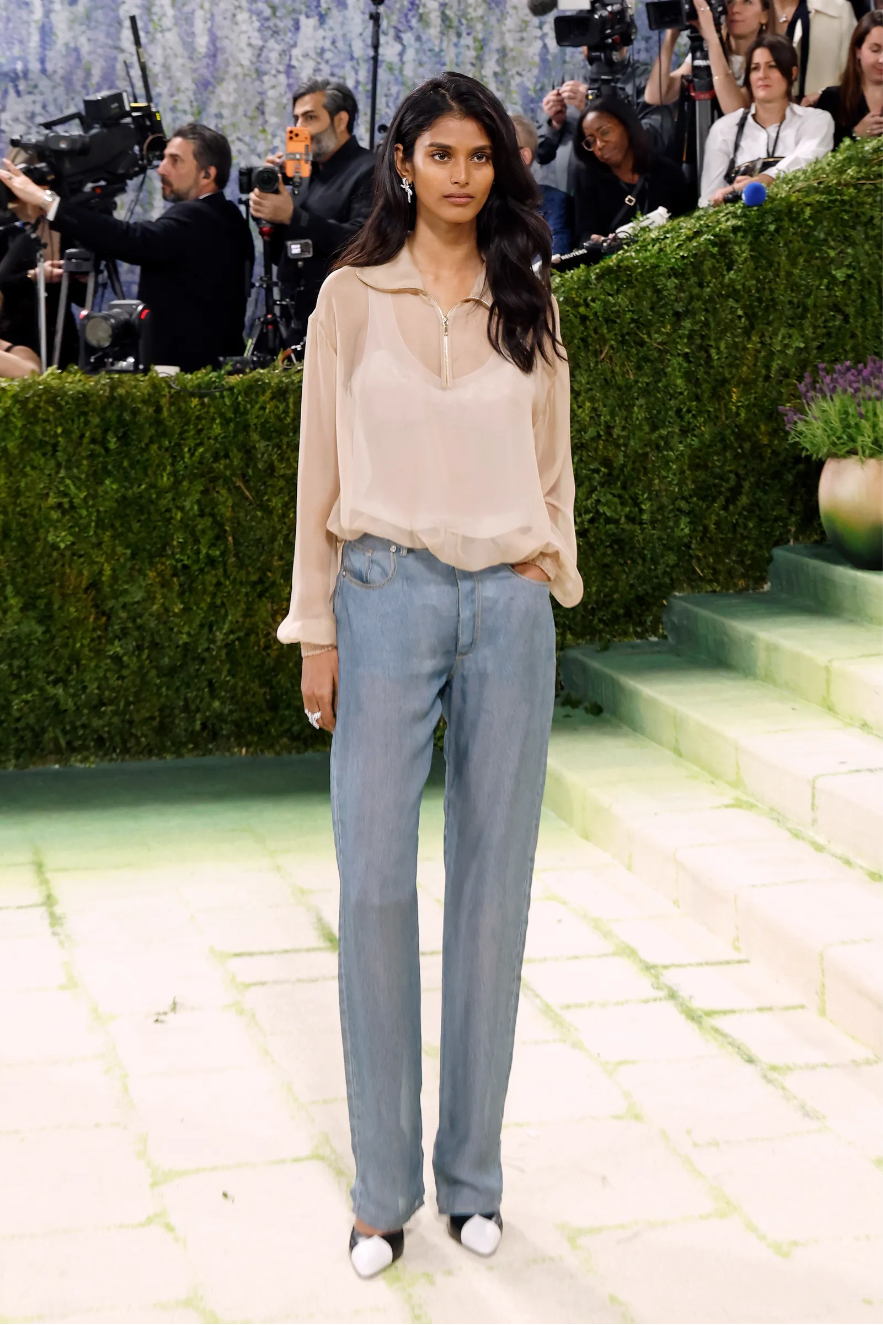
I. Introduction: When Denim Meets the Museum
On May 4, 2026, something seemingly impossible happened on the steps of the Metropolitan Museum of Art—jeans, the kind you wear to buy coffee on a Saturday morning, appeared on the most solemn night in fashion history.
Not just one pair, but several. Troye Sivan wore bright blue Prada jeans, the cuffs bunched around huge leather boots, the rips resembling lakes on a map. Zac Posen wore Gap flared jeans—the brand you grew up in department stores. Olivier Rousteing also wore jeans, though his Beyoncé gown was adorned with crystals.
Denim, this fabric originating from the working class and imbued with a rebellious spirit by James Dean and Marlon Brando, finally graced a stage it had never been invited to before.
II. Troye Sivan’s 1980s Ghost
Sivan’s look wasn’t simply about “wearing jeans to the Met Gala.” It’s a time capsule, an archaeological project about the downtown New York art scene.
His inspiration comes from Robert Mapplethorpe—the 1980s photographer known for his black-and-white nude photography, with his iconic, artistically tousled, devilish hairstyle. Sivan’s hairstyle replicates Mapplethorpe’s silhouette, and his black herringbone coat, white shirt, and “jeans”—actually special fabric treated with devoré—together form a “uniform of an 1980s New York photographer.”
“What I was thinking about was the work of the artists we lost to AIDS, and what it meant to be an artist in that era, in this city,” Sivan says. “Their work was so influential, and it will always be.”
This isn’t fashion; it’s remembrance. Sivan’s jeans aren’t just jeans; they’re the marks of time, the echoes of lost lives. Prada’s co-creative director, Raf Simons, is a recognized Mapplethorpe fan—the photographer’s work and iconic leather hat appeared in Simons’ Spring/Summer 2017 collection. Sivan’s look, therefore, is also an invisible thread extending from the 1980s to tonight.
III. Bhavitha Mandava’s Chanel Deception
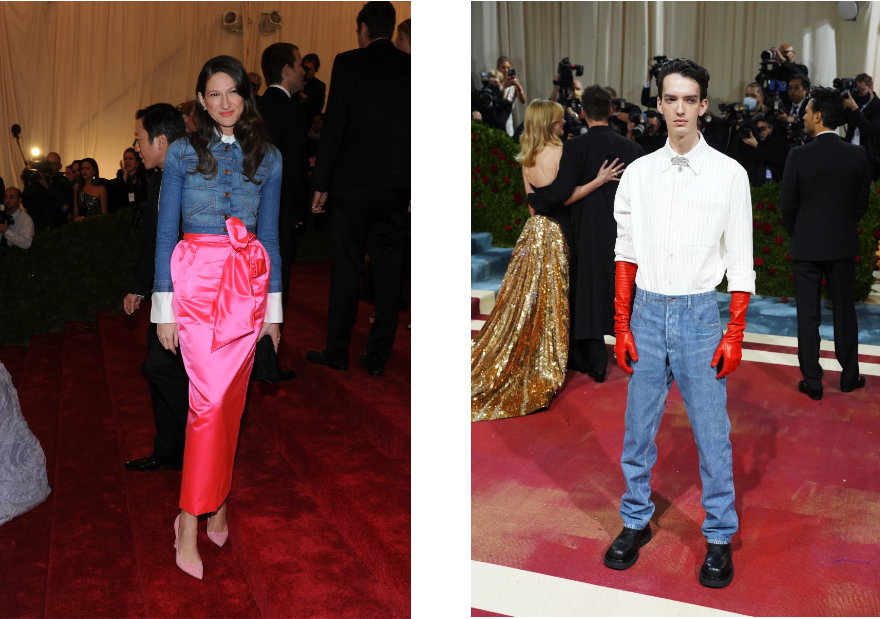
Indian model Bhavitha Mandava sparked the biggest debate—because she looked like she was wearing jeans to the Met Gala. Social media erupted with arguments: “I understand the theme, but this is too much.” “Stay home.”
But the truth is: those weren’t jeans.
Mandava wore a Chanel haute couture “jeans” that took 250 hours to make—using tweed and silk to mimic the texture and color of denim. The details that looked like pockets and stitching were hand-embroidered. The fabric that looked like a washed blue was woven from carefully blended yarns.
This is a trick about “seeing.” The audience thought they were seeing something (jeans), but actually saw something else (haute couture). Under the theme of “fashion is art,” Mandava’s look raises a core question: when art imitates the everyday, does the everyday become art? When a pair of “jeans” takes 250 hours to make, is it still a “jeans”?
IV. Zac Posen and Gap: The Return of the Mall
Gap’s creative director, Zac Posen, walked the red carpet in Gap’s flared jeans. This wasn’t irony, it was strategy.
Gap—the brand that defined American casual style in the 1990s, the brand that has struggled to redefine itself in recent years—re-entered the high-fashion dialogue through Posen’s presence. The silhouette of the flared jeans is an echo of the 1970s, but the wash and fabric are contemporary. Posen’s styling says: fashion doesn’t always have to look forward; sometimes looking back is also a form of progress.
Olivier Rousteing—the creative director of Balmain, the designer of Beyoncé’s crystal gown—also chose jeans. This is more like a gesture: while I design ultimate luxury for others, I choose simplicity for myself. This contrast creates a narrative tension about the relationship between the creator and the work.
V. The History of Jeans: From Workwear to Art
Denim’s appearance at the Met Gala wasn’t an invention of 2026; it’s the latest chapter in a long history.
In 1873, Levi Strauss and Jacob Davis patented studded work pants—durable clothing designed for miners and cowboys. In the 1950s, James Dean wore jeans in Rebel Without a Cause, giving them a symbolic meaning of rebellious youth. In the 1980s, Calvin Klein’s jeans ads brought denim into the realm of high fashion. In the 2000s, designer jeans (Seven for All Mankind, True Religion) drove denim prices into the triple digits.
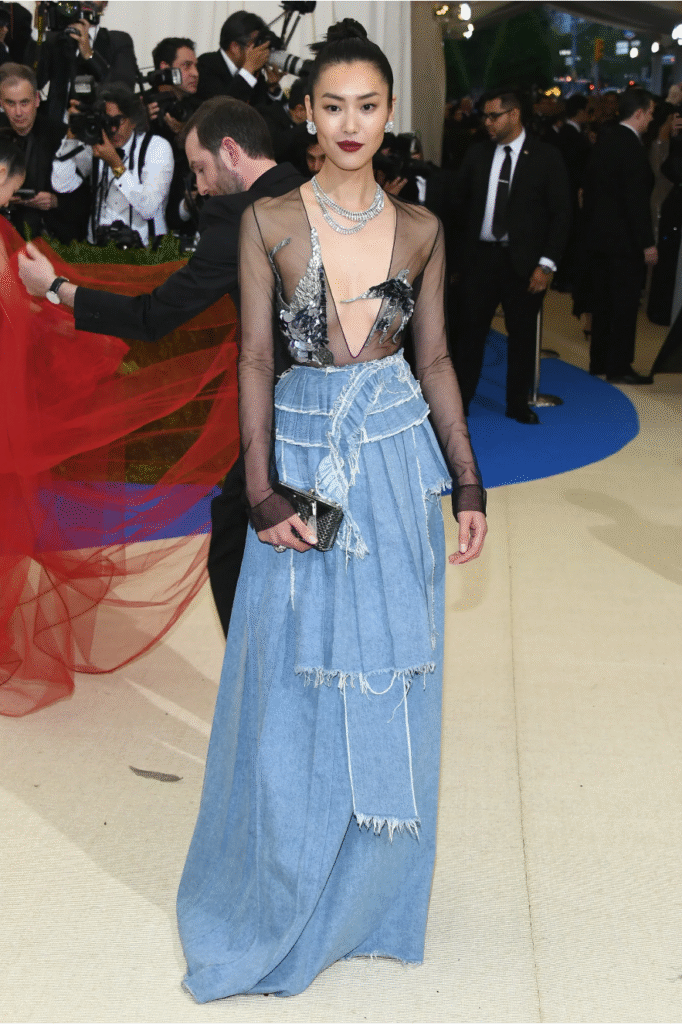
In 2016, Kanye West wore ripped Fear of God work pants to the Met Gala. In 2022, Kodi Smit-McPhee wore Bottega Veneta leather “jeans” (trompe l’oeil effect), while Ashton Sanders wore a Casablanca gold-trimmed Canadian tuxedo (real denim).
In 2026, denim was finally no longer a tolerated outlier, but an invited guest. Vogue’s headline directly proclaimed: “Jeans at the Met Gala? Yes, they belong here.”
VI. A Democratized Interpretation of “Fashion is Art”
The theme of the 2026 Met Gala was “Costume Art.” The exhibition explored the relationship between the body and clothing, spanning centuries of nudity, pregnant bodies, and aging bodies.
Jeans gained a new meaning in this context. If fashion is art, then does the most democratic clothing—the kind worn by billions of people every day—also deserve a place in a museum? Sivan’s Mapplethorpe tribute, Mandava’s Chanel deception, Posen’s Gap bell-bottoms—they all raise the same argument: art doesn’t have to be rare, expensive, or elitist. Art can be everyday, practical, and accessible to everyone.
This is a democratizing interpretation, but also a dangerous one. When Gap jeans and Chanel haute couture share the same red carpet, the economic divide between them is temporarily obscured. But the divide remains—Sivan’s “jeans” are from Prada, Mandava’s “jeans” took 250 hours to make, while real Gap jeans cost fifty dollars.
VII. On the Illusion of Reality
Ultimately, the jeans moment at the 2026 Met Gala was about illusion.
Sivan’s jeans weren’t real jeans; they were an illusion of devoré craftsmanship. Mandava’s jeans weren’t real jeans; they were a Chanel illusion. Posen’s jeans were real jeans, but Gap’s creative director wearing Gap was itself a performance.
Only Rousteing jeans—if they’re real—may be the only honest ones. But honesty, on the red carpet, is never the point.
The rise of denim tells us that the power of fashion lies not in what it is, but in what it makes us believe it is. A pair of jeans can be a symbol of the working class, a flag of rebellion, a vehicle for art, or an illusion of high society—depending on who wears it, where they wear it, and how we are guided to view it.
On May 4, 2026, on the steps of the Metropolitan Museum of Art, jeans completed their long journey through class. From the mines to the museum, from workers to celebrities, from practicality to art. This journey isn’t over yet—it’s just entering the next phase.