
I. The Stone Statue on the Steps
May 4, 2026, New York. Something incredible appeared on the steps of the Metropolitan Museum of Art—a marble statue, walking.
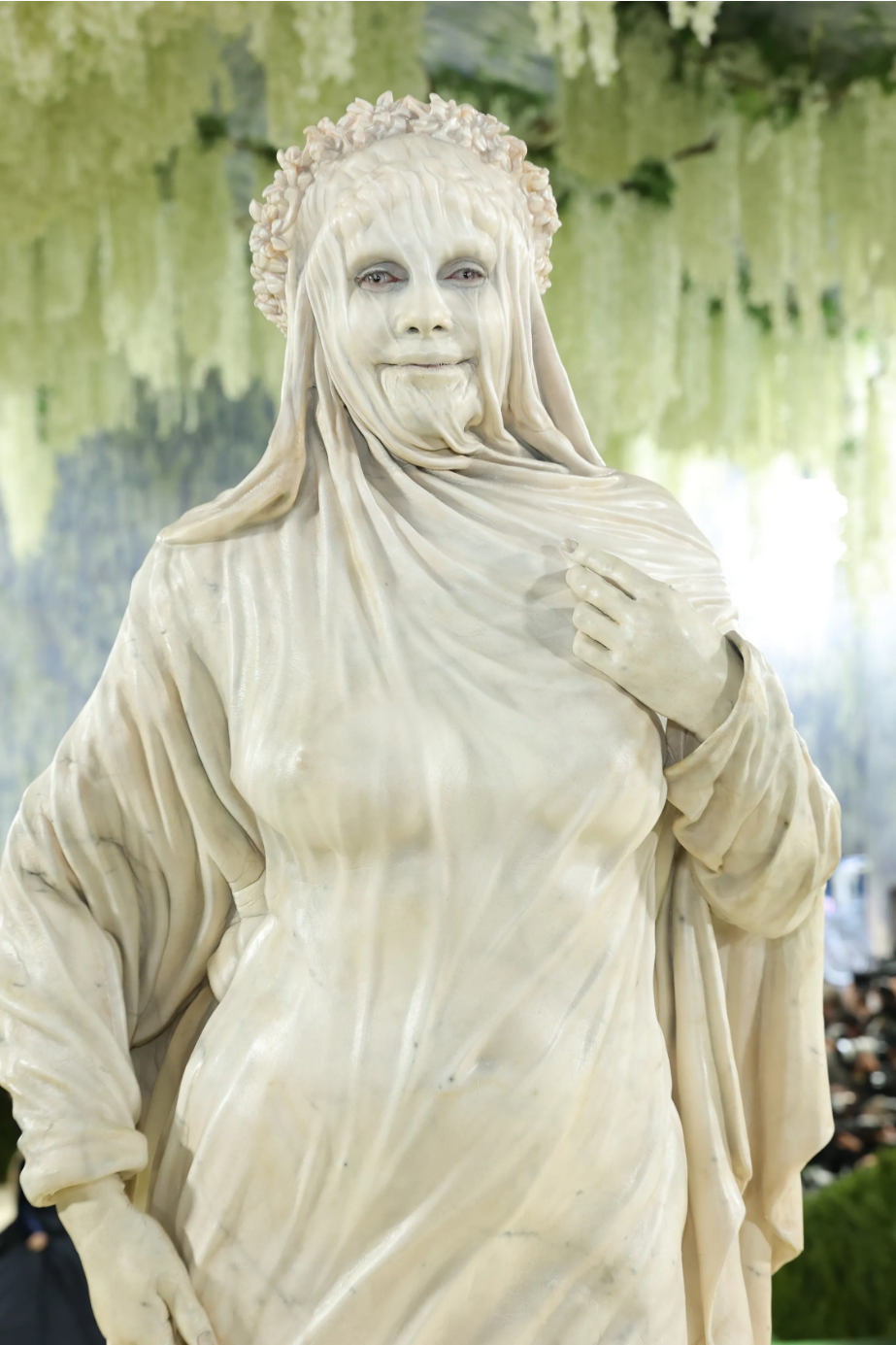
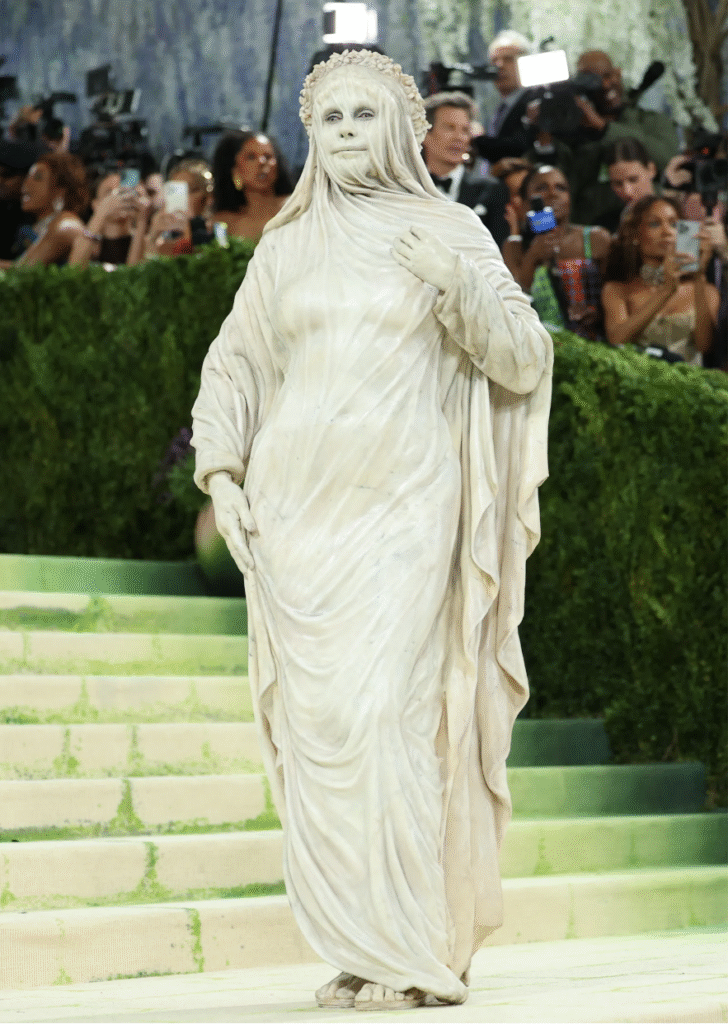
No, it wasn’t a statue. It was Heidi Klum. But when you first saw her, you would doubt your eyes. Her skin was the color of stone—travertine from Italian quarries, bearing the marks of time and weathering. Her face was covered, veiled by a sculpted, wrinkled “veil,” like Raffaelle Monti’s Veiled Vestal from 1847—the famous sculptural marvel that made marble appear as a veil.
But Klum was moving. She was breathing. She walked up the steps, and the wrinkles of the “stone” undulated slightly with her steps. This was magic—not the magic of technology, but the magic of art, the magic of Mike Marino.
II. From Halloween to May
We all know who Heidi Klum is. She’s the queen of Halloween—the woman who transforms herself into a bug, Medusa, E.T. Her annual Halloween party is New York’s most unpredictable spectacle, a carnival of metamorphosis.
But tonight isn’t October. Tonight is May, the Met Gala, the most solemn night in fashion. And Klum—the woman who forever refuses to be categorized, refuses to be tamed—has decided to bring her Halloween spirit to the May steps.
“I want to be her,” Klum said of Veiled Vestal. “I started at the Metropolitan Museum of Art. I walked in and lingered before Raffaelle Monti’s sculptures—those 19th-century works, those miracles that made marble look like fabric, like a veil, like breathing. I looked at them and thought: How is this possible? How can stone be so soft? And then I thought: Why can’t I?”
III. Mike Marino’s Hands: From 3D Scan to Living Sculpture
Mike Marino isn’t a fashion designer. He’s a special effects makeup artist and Klum’s longtime Halloween partner. Their collaboration began on those crazy October nights—insects, Medusa, Fiona, peacocks. But tonight, they took that collaboration to another level.
The process went like this: First, a 3D scan of Klum’s entire body—every curve, every angle. Then, based on that scan, the team began sculpting. Not with marble, but with foam and latex. Those parts that look like wrinkles in stone are actually soft, flexible materials, precisely sculpted into the contours of ancient sculptures.
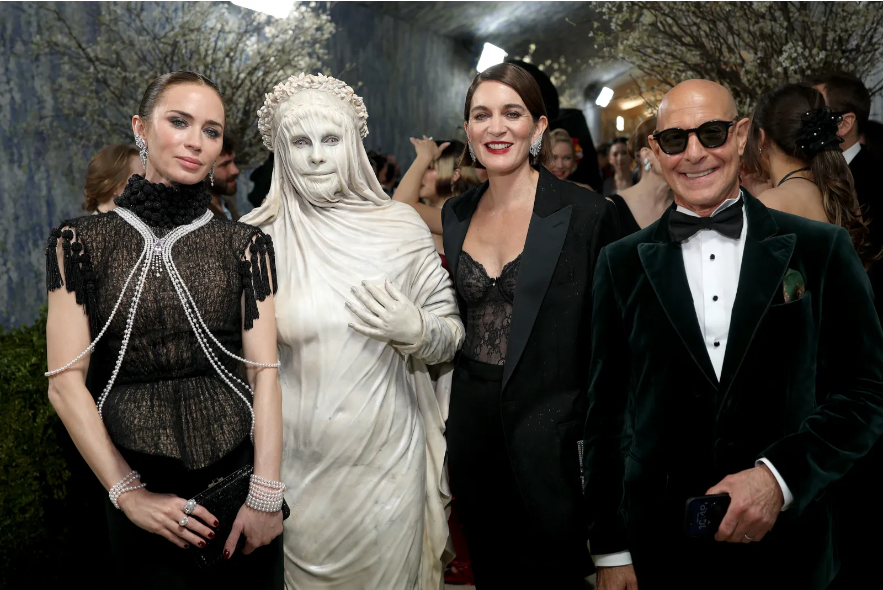
“Heidi will become a living sculpture,” Marino said in a behind-the-scenes video, “standing on the steps of New York’s greatest museum—and one of the greatest museums in the world.”
The ambition in that statement is dizzying. It’s not about “wearing” a work of art, but about “becoming” a work of art. It’s not about referencing the classics, but about revitalizing them. Klum’s body—consumed countless times by fashion magazines, television screens, and red carpet photos—is tonight recoded as a museum piece.
IV. The Paradox of the Veil
The core paradox of Veiled Vestal is Monti’s signature technique: sculpting a soft veil from hard marble, making the stone appear like fabric that could be blown by the wind. Klum’s styling reverses this paradox: she uses soft foam and latex to create the illusion of stone.
“I look hard, but I’m soft,” Klum joked on the red carpet. “It’s foam and latex.”
This game between hard and soft is the perfect interpretation of tonight’s theme, “Costume Art.” The exhibition explores the relationship between clothing and the body—nudity, the pregnant body, the aging body. Klum’s body, shrouded in artificial stone, is both concealed and displayed. The veil doesn’t hide her face; it redefines it. Viewers no longer see “Heidi Klum,” but a classical, anonymous, and timeless female figure.
V. Temperature and Discomfort
Klum admits the outfit was “a little hot,” “a little scorching.” She joked that preparation time was only “20 minutes”—obviously impossible, but such exaggeration is part of her style. The real preparation time was likely hours: 3D scanning, sculpting, body painting, and prosthetic attachment.
But discomfort is part of the transformation. On Halloween 2022, while wearing her famous worm costume, Klum didn’t go to the bathroom all night. “Halloween isn’t about comfort,” she said. Neither is tonight’s Met Gala.
This acceptance of discomfort is at the heart of Klum’s aesthetic. She’s willing to sacrifice convenience for effect, willing to endure constraint for spectacle. This isn’t vanity; it’s dedication—an almost religious dedication to the performing arts.
VI. The Social Media Divide
Klum’s transformation sparked the typical polarized reactions on social media. “I understand the theme. But this is too much,” one X user wrote. Another said, “Stay home, Heidi.” But others cheered: “Heidi always wins.” “You know what…go for it, girl!”
One comment captured the essence of the Klum paradox: “I recognize Heidi Klum in a prosthetic than the real Heidi Klum.” This is both praise and diagnosis. Klum’s ordinary image—the woman who critiqued designers on Project Runway and posted beach photos on Instagram—is less memorable than her anamorphic form. Her true identity, in a way, is those prosthetics, those makeup, those impossible creations.
VII. From 2003 to 2026: Twenty-Three Years of Met Gala Evolution
Klum first attended the Met Gala in 2003. What did she wear then? A beautiful dress, no doubt, but that’s the “fashion” Met Gala—about clothes, about designers, about red carpet photos. Tonight’s Met Gala is about “art”—about the body as a canvas, about clothing as sculpture, about the wearer as a performer.
In 2025, Klum returned after a long absence, wearing a black strapless Vetements gown with the brand’s signature black and white tag trim. It was understated, restrained, a precise response to the “Tailored for You” theme. But in 2026, she unleashed pent-up drama—not gradually, but explosively.
From the silver Marchesa in 2013 to Vetements in 2025, and to tonight’s stone prosthetic, Klum’s Met Gala trajectory depicts an evolution from “pretty” to “art,” from “dressing” to “being.” She’s no longer content to be photographed; she wants to be remembered.
VIII. A Living Museum
When Klum walks the steps, she’s more than just a guest. She is a walking work of art, a living testament to the theme “fashion is art.” Her body—52 years old, reshaped from latex and foam, covered in gray paint, possessed by the ghost of classical sculpture—challenges every convention of the red carpet.
The Metropolitan Museum of Art’s “Costume Art” exhibition runs until January 2027. Klum’s look won’t be on display there—it’s too fleeting, too reliant on her body, too unrepeatable. But its spirit—the spirit that sees the body as a canvas, clothing as sculpture, and wearing as a performance—will permeate the entire exhibition.
“A piece of haute couture is reimagined as art in motion,” Klum wrote on Instagram. This isn’t a humble statement; it’s an accurate one. Tonight, she is not Heidi Klum. She is the 21st-century version of Veiled Vestal, the feminine embodiment of Giuseppe Sanmartino’s Veiled Christ, a miracle of stone learning to breathe.
And a miracle is exactly what this night needs.