
I. A Newcomer on the Steps
On May 4, 2026, a newcomer appeared on the steps of the Metropolitan Museum of Art.
Hudson Williams—a name that belonged only to hockey enthusiasts a year ago, but tonight, it belongs to fashion. The 25-year-old from British Columbia, who transitioned from athlete to actor with Heated Rivalry, now stands on the steepest steps of the fashion world.
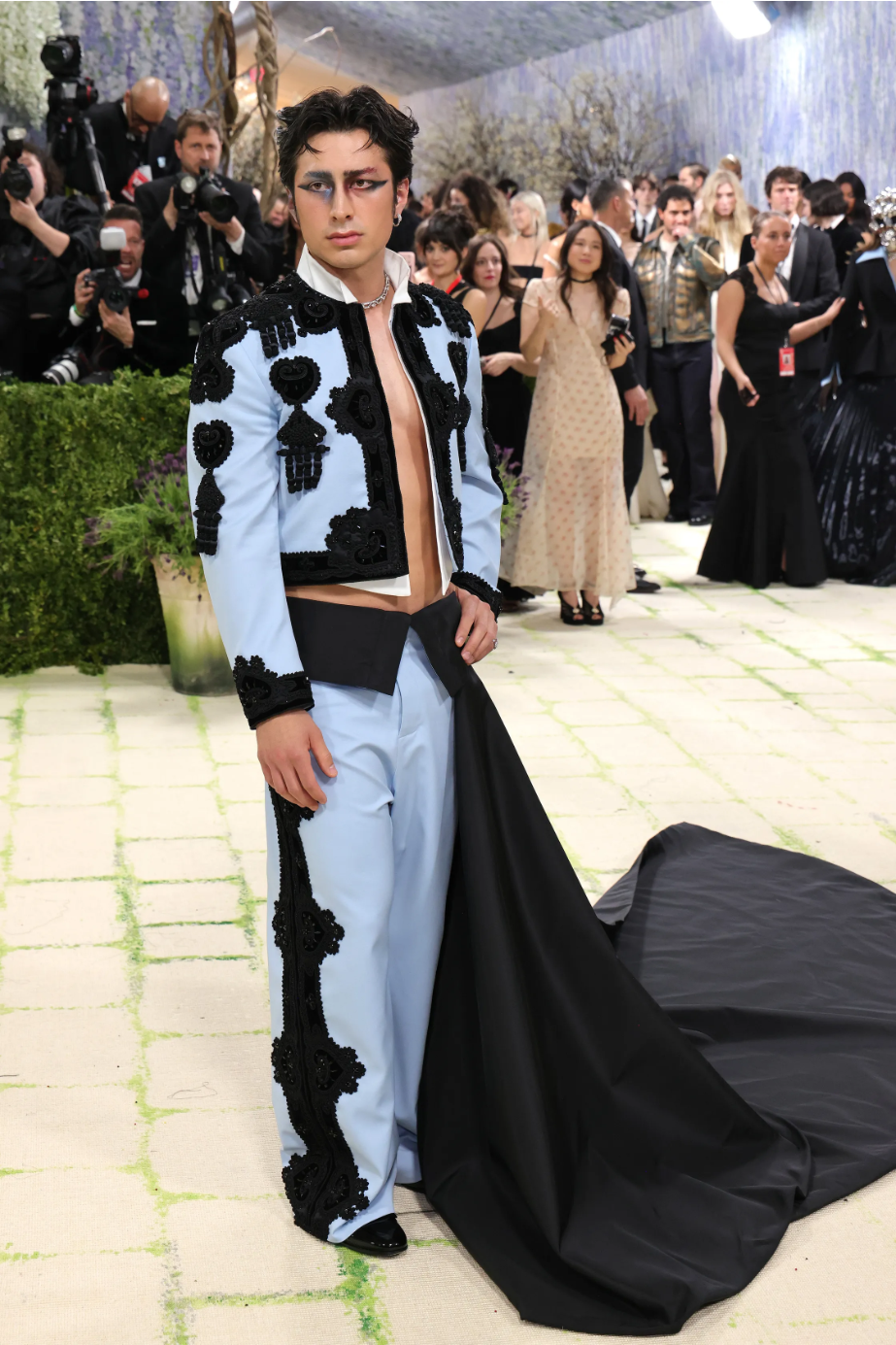
He wore a baby blue Balenciaga two-piece suit, in the silhouette of a matador. Black crystal embroidery outlined the jacket’s edges, black tassels cascaded at the seams, and a black cape cascaded down his shoulders, casting a shadow on the steps. The jacket was open, revealing his chest, and a diamond necklace sparkled at his collarbone like a perched bird.
This was his Met Gala debut. For someone who, just six months ago, was stumbling like Bambi on the Milan Fashion Week runway, this debut is a dizzying leap.
II. From Hockey to the Runway: The Retraining of the Body
Williams’ body was shaped by hockey—broad shoulders, a thick chest, an athlete’s gait. At the Dsquared2 show, he admitted to feeling “very uncomfortable,” “not like I was acting,” and “definitely going to walk out like a chick—like Bambi.”
But tonight, that uncomfortable body was retrained. Balenciaga’s bullfighter suit demanded a different posture: open chest, back shoulders, slow and deliberate steps. It wasn’t an athlete’s sprint, but a bullfighter’s stroll—showing control before the bull, elegance before death.
The cropped length of the jacket exposed the waistline, a confident display of the athlete’s body. But the open chest and exposed skin also bring a sense of vulnerability—a declaration of “I am here, I am exposed, I am fearless.”
III. The Ghost of Cristóbal
The roots of this suit can be traced back to a bolero jacket designed by Cristóbal Balenciaga in 1947. That Spanish designer, that genius known for his sculptural tailoring, infused his work with memories of his homeland—the dust of the bullring, the folds of flamenco, the solemnity of religious processions.
The current creative director has revitalized this archive. The choice of baby blue is key—not the traditional red or black of Spanish bullfighters, but a deliberate softening, a hue that transforms masculine ritual into contemporary fashion.
Black crystal embroidery is another key element. They create a contrast against the baby blue background: softness and hardness, sweetness and sharpness. Williams’ body is framed by these crystals, like a painting being framed.
IV. The Makeup of the Black Swan
If the costume is that of a bullfighter, the makeup is a completely different language.
Williams’ eye makeup—which he himself revealed—was inspired by the 2010 film Black Swan. Blue and red eyeshadow is blended on the eyelids, resembling bruises or wings, while the eyeliner curls outwards like a bird’s tail feathers. This juxtaposition of makeup with the bullfighter’s attire is deliberate: masculine contours, feminine colors; classical references, contemporary variations.
One menswear critic’s assessment was sharp: “The exaggerated smoky eye makeup pushes the look into the realm of pure performance. I understand the intention, but to me it crosses the line into comedy. Without it, the tailoring and cape are enough to sustain the entire look.”
This criticism is fair. The makeup does indeed elevate the overall look from “fashionable” to “dramatic”—not in a derogatory sense, but as a choice. On the red carpet, Williams said his stylist, Anastasia Walker, had a philosophy that was “not about styling, but about making them the best version of themselves.” But tonight, “the best version of themselves” seemed to involve a kind of role-playing: bullfighter, black swan, hockey player, actor—all identities competing on the same body.
V. Bvlgari Diamonds: Punctuation Markers on the Body
Williams’s choice of accessories was precise. A Bvlgari diamond necklace with a pear-shaped pendant dangling between his sternum; a diamond pinky ring; a single hoop earring. These jewels weren’t decorations, they were punctuation marks—they created a focal point on the bare chest, guiding the eye down from the face and then resting on the heart.
This combination of jewelry and bare skin is rare on the men’s red carpet. Traditionally, men’s red carpet styling tends to be conservative—suits, ties, cufflinks, and at most a necklace. Williams’ open-chested jacket and diamond necklace broke this conservatism, placing the male body in the same “being-seen” position as the female body.
This is Balenciaga’s signature approach: juxtaposing the everyday with the extreme, combining working-class references with haute couture craftsmanship. Williams’ suit, from a distance, is an exquisite tailored suit; up close, it’s a deconstructed bullfighter’s outfit, paired with black swan makeup and the physique of an ice hockey player.
VI. A Confrontation with Connor Storrie
Williams isn’t the only one to make his Met Gala debut with Heated Rivalry. His partner, Connor Storrie, also made her Met Gala debut, wearing a Saint Laurent polka-dot top and suit, a stark contrast in style—classic, elegant, and with a touch of retro playfulness.
The two took a mirror selfie in the after-party restroom—not the formality of the red carpet, but the relaxed backstage. This contrast is intriguing: Storrie’s look is about “fitting in,” while Williams’s is about “standing out.” One chooses safety, the other adventure.
Throughout awards season appearances, Williams and Storrie have created a visual counterpoint. Storrie’s Tiffany jewelry and Omega watch represent traditional masculine luxury; Williams’ Bvlgari necklace and open-chested jacket challenge that tradition. They are like complementary colors, defining each other on the red carpet.
VII. The Performer’s Body
In an interview with Wonderland, Williams said that the Dsquared2 show was “a fun place where you can swagger. I could have swaggered, I could have walked more powerfully.”
Tonight, he certainly swaggered. But swaggering on the Met Gala steps is a complex gesture—it’s both confidence and performance; both the authentic self and the role played. Williams’ body, from the hockey rink to the runway to the red carpet, is undergoing a continuous transformation: the athlete’s body is recoded into a fashionable body, and the fashionable body is recoded into an artistic body.
That baby blue matador suit stayed on the red carpet for less than thirty minutes. Then it was taken off, put away somewhere, or forgotten. But that posture—the open chest, the black cape, the slanted eyeliner—will remain in some form. Not as a memory of a garment, but as a memory of a question: when an athlete dons a bullfighter’s costume, who is he truly playing?
The answer might be: everyone, and yet no one. Under the theme of “fashion is art,” Williams transformed himself into a living collage—ice hockey, bullfighting, ballet, film—fragments coexisting briefly on his body before dissipating.
This is the significance of his debut: not about perfection, but about possibility. Williams’ first step at the Met Gala was a large, resounding, and perhaps even overdone one. But sometimes, overdoing it is precisely what the night needed.