
I. Dusk in Central
In May, dusk falls slowly in Hong Kong. The mist on Victoria Peak hasn’t completely dissipated, yet the office buildings in Central are already lit. Those lights, one by one, are like someone slowly spreading out a deck of cards in the darkness.
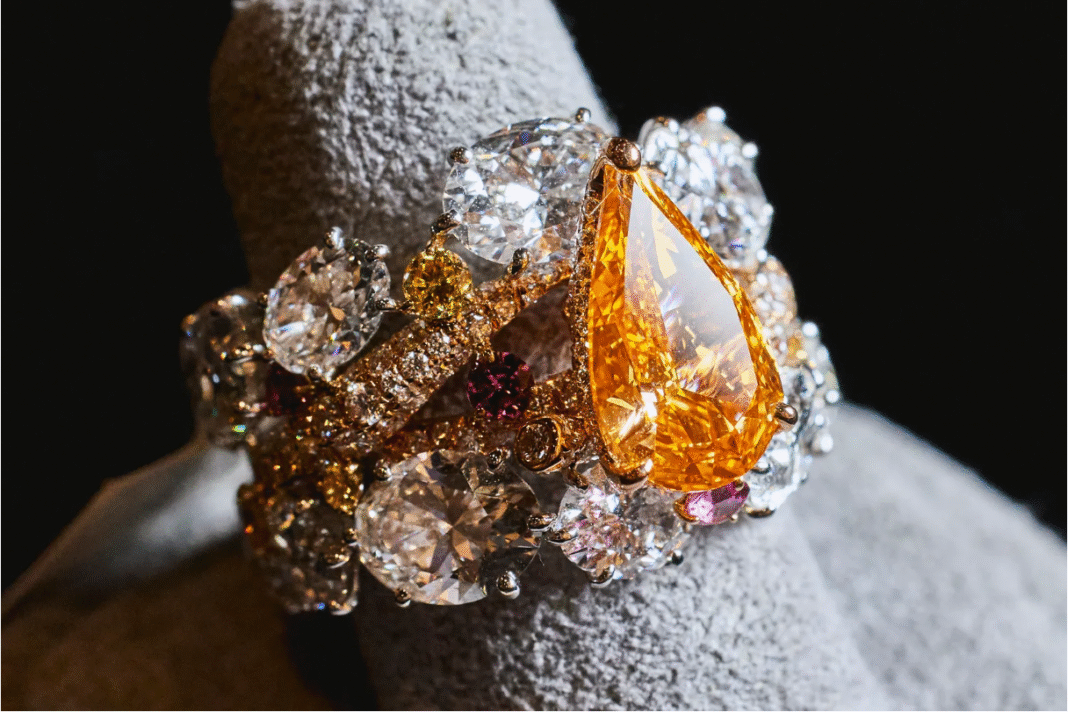
Christie’s new headquarters is on the seventh floor of The Henderson. Outside the glass curtain wall is the grey-blue of Victoria Harbour; inside, a different scene unfolds—diamonds gleam coldly under spotlights, jade glows warmly green on velvet, and a Hermès Birkin bag sits in a glass case like a carefully venerated shrine.
This year marks Christie’s fortieth year in Asia. Forty years is enough for a person to grow from youth to middle age, enough for a city to transform from a fishing village into an international financial center, and enough for an auction to go from a tentative exploration on the fringes to a mainstream celebration.
Standing in the exhibition hall, looking at the items about to be priced, I suddenly recalled Eileen Chang’s words: “Life is a magnificent robe, crawling with fleas.” Aren’t these jewels, watches, handbags, and wines the same? Their exteriors are glamorous, but beneath lies the desire, anxiety, and obsession of “must possess.”
II. Jewelry: The Eternal Lure
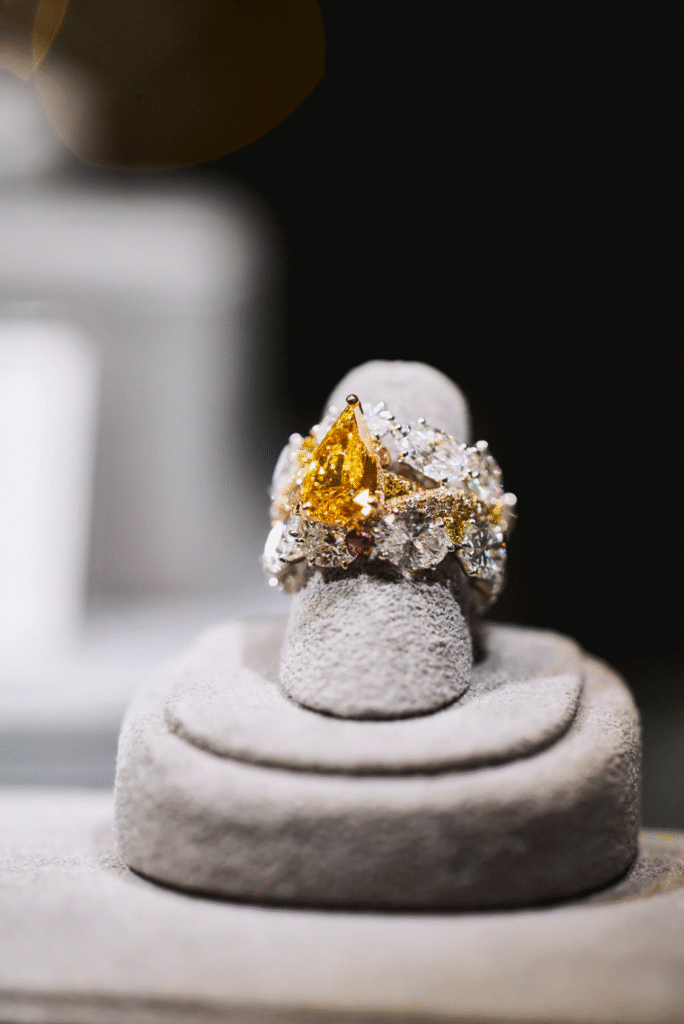
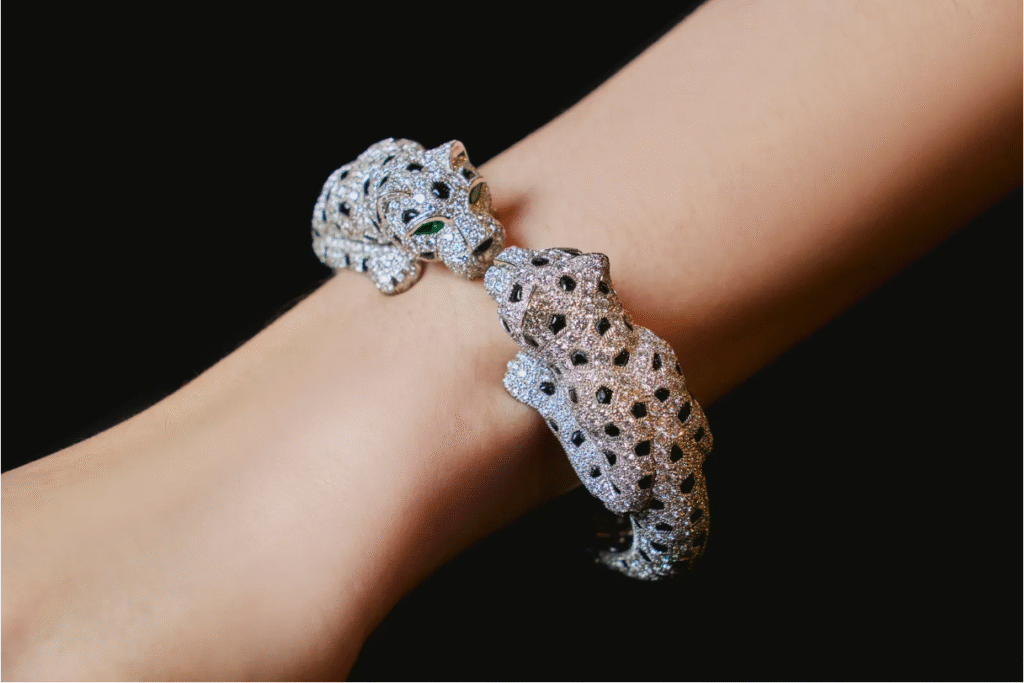
The highlight of auction week is always jewelry.
“The Regent Kashmir”—a 35.09-carat natural royal sapphire from Kashmir, paired with a diamond ring. Its blue isn’t a flamboyant, clamorous blue, but a deep, almost melancholic royal blue, like a memory mined from the depths of a glacier in the Himalayas. Estimated at HK$20-30 million.
And then there’s “The Regal Ruby,” a 13.22-carat unheated Burmese ruby. Red in Eastern culture is always auspicious, passionate, and full of vitality. But within the red of this ruby, there seems to be a hint of blood, a trace of fate from the depths of the mine, a whisper of the miners’ destinies. It is poised to become the highest-priced Burmese ruby to sell at Christie’s Hong Kong in nearly a decade.
I am reminded of Rosamund Kwan. A few years ago, Christie’s auctioned her private jewelry collection, including a 12.46-carat Burmese ruby ring, which ultimately sold for over HK$20 million. Those jewels once adorned her earlobes and entwined her fingers, witnessing her peaks and troughs. Now, they have changed owners, continuing to circulate through different bodies, like an endless cycle.
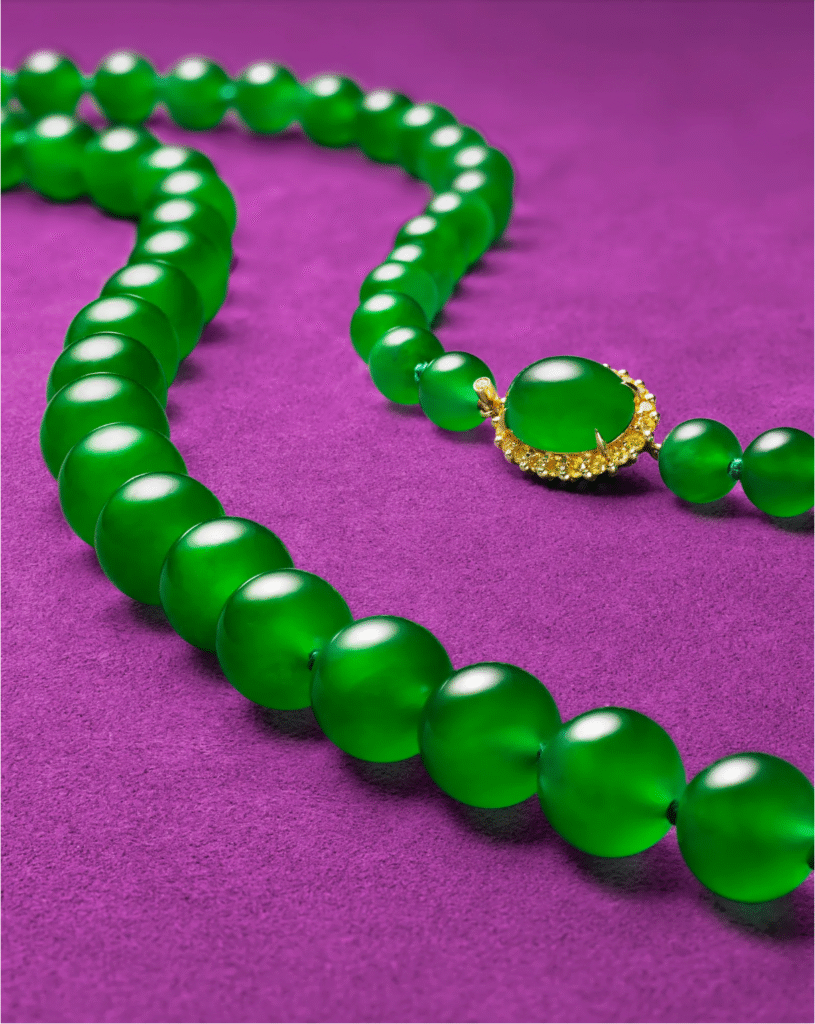
Jewelry is the most honest lie. It promises eternity, yet it’s always changing hands; it symbolizes love, yet often becomes the liquidation item after a breakup; it boasts rarity, yet appears in batches at auctions. But people still relentlessly pursue them, because in this uncertain world, the hardness of a diamond is at least more reliable than the human heart.
III. Handbags: A Totem of the New Era
If jewelry is the remnant of the old era, then handbags are the totem of the new era. Christie’s “Elegant Heritage: Handbags and Accessories” sale brought together over two hundred pieces from Hermès, Chanel, and Louis Vuitton. Among them was a globally rare 40cm black saltwater crocodile diamond Birkin bag; its scales shimmered like black armor under the lights, and the diamond clasp gleamed with a cool light.
Also featured was a two-tone crocodile Kelly doll bag making its auction debut. Matte pink, 25cm long, it combined rare materials with exquisite craftsmanship. Small enough to hold only a lipstick and a credit card, it was large enough to carry a woman’s entire ambition.
These handbags often cost more than a mid-size car. But those who bought them often already owned one or even several cars. A handbag is not a tool, but a badge—a silent declaration of “I belong to a certain class.” In this sense, Hermès’ orange box is more convincing than any diploma.
I thought of the women queuing in front of the boutiques. They were impeccably dressed, their makeup flawless, holding numbered paddles, their eyes filled with an almost reverent anticipation. They were waiting for more than just a bag; they were waiting for a ticket to a certain circle, proof of recognition, a self-affirmation of “I am worthy too.”
But handbags are also among the most easily outdated items. This year’s hottest style might be relegated to the back of the closet next year; this season’s color might seem jarring next season. That’s why auction houses are so important—they give outdated handbags renewed value, allow weary owners to cash in, and give new seekers the chance to own a dream they once missed.
IV. Luxury Watches: Prisoners of Time
Watches are the most contradictory luxury items. They measure time, yet attempt to transcend it; they remind us of the finiteness of life, yet simulate eternity with intricate mechanics.
The leading focus of Christie’s auction this time is an F.P. Journe Sonnerie Souveraine wristwatch. With its striking function, complex movement, and every mark on the dial meticulously crafted by artisans using magnifying glasses and tweezers, this watch is a masterpiece of craftsmanship. Its price wasn’t publicly disclosed, but connoisseurs know that a watch of this caliber starts at seven figures.
There’s also the Rolex 6100 from around 1954, its dial adorned with a magnificent cloisonné enamel dragon design. Enameling—this ancient craft—requires artisans to use extremely fine brushes under a microscope to meticulously fill the grid of metal wires with a mixture of mineral powder and pigment, then repeatedly fire it. A single dial can take months, even a year, to complete. The dragon, with its distinct scales and flowing whiskers, seems poised to leap from the dial at any moment.
The owners of these watches are often those who least need to check the time. Their schedules are arranged by assistants, their meetings are never late, and their time is measured in minutes. Yet, they still need a prestigious watch, because on certain occasions, the act of glancing at one’s watch is itself a gesture—a gesture of “my time is precious,” a gesture of “I appreciate the beauty of mechanics,” a gesture of “I can afford this beauty of uselessness.”
Time is the fairest tyrant, treating everyone equally. But luxury watches make this fairness less glaring—at least, for a fleeting moment, you can pretend you possess some power beyond time.
V. Wine: Liquid Memory
The auction week opened with two private cellar auctions—”The Liu Luanxiong Elite Wine Collection, Part III” and “The Ultimate Private Cellar Collection of Exceptional Provenance.”
Liu Luanxiong is a household name in Hong Kong. His collection, from art to wine, from jewelry to real estate, is all top-tier. His wine cellar reportedly contains thousands of bottles of top vintage wines from Bordeaux, Burgundy, and Champagne. These wines have slumbered in his cellars for decades, awaiting a special moment to be unearthed.
But that special moment often doesn’t arrive. Or, when it does, the owner has changed his mind and decided to convert them into cash. Thus, these wines move from private cellars to the public auction floor, from one person’s memory to another’s investment.
Wine is the most emotional investment. It can spoil, it can evaporate, and it can turn into vinegar if stored improperly. But it can also improve over time—at least in theory. A bottle of 1982 Lafite, stored properly for forty years, is said to have an aroma that can bring tears to your eyes when opened. But this “improvement” is subjective, unquantifiable, and unguaranteed. You’re not buying wine; you’re buying a promise about the future, a fantasy about “waiting for some important moment.”
At auctions, wines are often neatly arranged in wooden crates, labels facing out, like rows of soldiers awaiting inspection. Buyers hold catalogs, carefully examining the vintage, region, rating, and storage records. They’re not buying wine; they’re buying certainty—a certainty that “this wine is real, it’s good, it’s worth it.”
But ultimately, wine is meant to be drunk. The moment the cork is pulled out, all the investment value vanishes, leaving only the liquid’s memory—of a particular year’s sunshine, rain, and soil; of a winemaker’s decisions; of a cellar owner’s waiting. Then, it becomes a memory, a story, a hangover the next morning.
VI. The Auctioneer’s Gavel: The Final Verdict
The auctioneer stands on the platform, holding the small gavel. His voice is clear, calm, and emotionless, like a judge delivering a verdict.
“Twenty million, anything higher? Twenty million for the first time, twenty million for the second…”
The room falls silent. All eyes are fixed on the number raised on the paddle. The man sits in a corner, his face indistinct, but his posture composed. He might be a collector, an agent, or a businessman laundering money. No one knows, and no one cares. In an auction, only the price is real; everything else is speculation.
“Sold!”
The gavel falls, making a crisp sound. The sound isn’t loud, but in the quiet exhibition hall, it’s like a slap, or a kiss.
This item has a new owner. Its history has turned a new page, its value has been reaffirmed, and its future has been rewritten. The person who lost the bid might be more aggressive on the next item, or might leave early to have a drink in a Lan Kwai Fong bar, drowning their regret in whiskey.
Auctions are the most brutal form of democracy. They don’t ask about your background, your education, or your moral character. They only ask one question: How much are you willing to bid? On this question, billionaires and ordinary people stand on the same starting line—though their destinations are clearly different.
Seven or Forty Years: From the Periphery to the Center
In 1986, Christie’s held its first auction in Hong Kong. At that time, the Asian art market was still small, collectors were few, and the concept of “investing in art” was still unfamiliar to most people. Christie’s arrival was like a missionary from the West, bringing new rituals, new language, and new values.
Forty years later, Hong Kong has become one of the world’s three major art trading centers, alongside New York and London. Asian collectors are no longer marginal participants, but a dominant force in the market. The purchasing power of Chinese buyers, the rise of Indian buyers, and the activity of Southeast Asian buyers—these forces have reshaped the landscape of the global art market.
Christie’s, over the past four decades, has witnessed and driven this change. It brought Western Impressionism, Modernism, and Contemporary Art to Asia, and promoted Asian art such as Chinese calligraphy and painting, Japanese Ukiyo-e, and Southeast Asian contemporary art to the world. It created a platform for objects from different cultures, eras, and values to engage in dialogue within the same space.
But this dialogue is unequal. The rules of auction houses are Western, the language is English, and the aesthetic standards are Eurocentric. Asian collectors in this system are both participants and those being disciplined. They learn how to appreciate art “correctly,” how to collect “professionally,” and how to invest “rationally.” Their tastes are shaped, their desires are guided, and their identities are affirmed.
Is this progress or colonization? There is no simple answer to this question. Perhaps both. Perhaps in this era of globalization, distinguishing between progress and colonization is itself a difficult task.
VIII. In Conclusion
The morning after the auction week ended, I went to Christie’s again. Staff were packing up; the jewelry in the glass cases had been moved into safes, the paintings on the walls had been removed, leaving only empty walls and footprints on the carpet.
Sunlight streamed in through the floor-to-ceiling windows, dust motes dancing in the beams of light. Those items, just bought at high prices, were now being packed, crated, and shipped to new homes around the world. They would slumber in new safes, be displayed in new galleries, and be told in new stories.
Standing in the empty gallery, I recalled another quote from Eileen Chang: “Because of understanding, there is compassion.”
These jewels, handbags, watches, and wines—they are more than just objects. They are containers of desire, symbols of status, witnesses to time, and carriers of memory. They bear the weight of human greed and dreams, vanity and sincerity, the fleeting and the eternal.
At the moment the gavel falls, all these complex emotions are simplified into a single number. But behind the numbers lie countless stories—stories of gain and loss, of pursuit and abandonment, of how we define our own value in this bustling yet desolate world.
Christie’s forty years are forty years of Hong Kong, forty years of Asia, and forty years of luxury as a cultural phenomenon. What will the next forty years bring? Nobody knows. But one thing is certain: as long as humanity has desires, vanity, and a yearning for beauty, the auction hammer will continue to fall, continuing to write stories of possession and being possessed.
And I am merely an observer. Standing in a corner of the exhibition hall, watching the sunlight slowly move, watching the dust slowly settle, watching this bustling world continue its cycle with the sound of the auction hammer.