
I. The Anonymous Figure on the Red Carpet
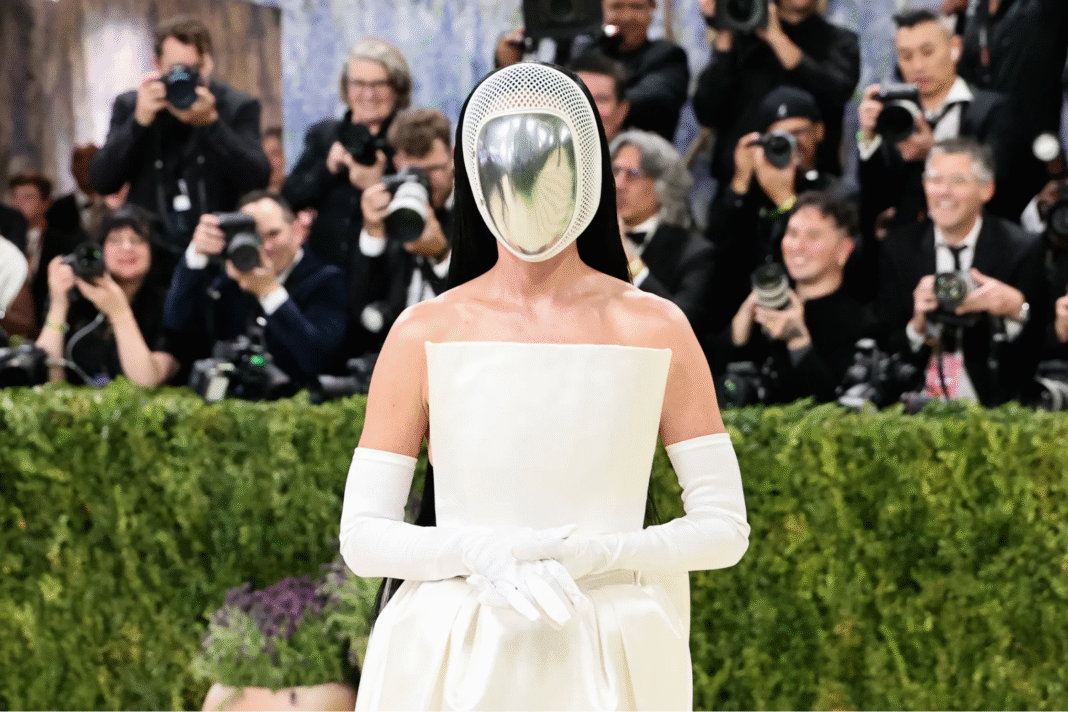
On May 4, 2026, an anonymous figure appeared on the steps of the Metropolitan Museum of Art.
She wore a white satin Stella McCartney gown, draped at the shoulders and trailing on the floor, with white opera gloves extending to her elbows. But her face—the face recognized by hundreds of millions worldwide—was completely obscured. A silver chrome metal mask covered her entire face, its outline defined by a white mesh frame, resembling a fencing helmet from the future or some kind of space-age breathing apparatus.
This was Katy Perry. But she chose to remain unseen on this night.
II. Stella McCartney’s Environmental Narrative
Perry’s gown was from Stella McCartney’s couture collection. The fabric was Italian stock satin woven from forest-friendly viscose fibers, recycled from leftover fabrics from the Italian tailoring industry. This was a statement about sustainability, but tonight, it was overshadowed by another, more powerful statement: the mask.
McArtney’s design language has always been known for its clean, modern, and slightly boyish silhouettes. But tonight’s piece—the purity of the white satin, the classic elegance of the gown, the ceremonial feel of the gloves—is closer to the traditional grammar of haute couture. McCartney is exploring a territory she doesn’t often venture into: drama.
This attempt is clever. As Perry’s body is draped in white satin, the mask becomes the sole focal point. The body recedes, the mask advances. This isn’t about clothing; it’s about concealment.
III. The Semiotics of the Mask
That silver mask wasn’t a casual accessory. According to Perry’s team, designed by Miodrag Guberinic, it “aimed to be a literal and symbolic reflection, inviting the observer to consider: how their perception of others maps to their own inner world, and conversely, how it obscures the truth.”
This sounds more like an art critic’s essay summary than a description of a red carpet look. But that’s Perry’s way—she always tends to over-interpret, packaging her fashion choices as philosophical manifestos.
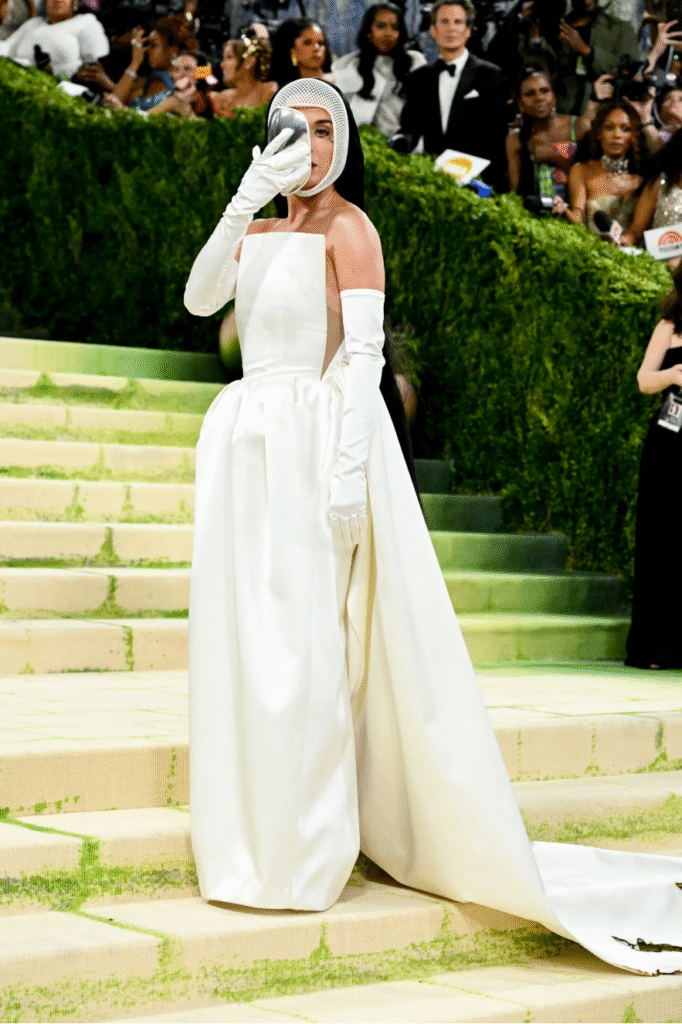
The mask’s actual effect is more direct: it makes Perry unrecognizable. On a night when everyone craves to be seen, she chose anonymity. This inversion is powerful. While other celebrities strike elaborate poses on the steps, displaying their faces and bodies, Perry’s face becomes a mirror—reflecting not herself, but the viewer themselves.
Four, the Six-Finger Glove: The Ghost of AI
One of Perry’s white gloves has a sixth finger. It’s a delicate, almost overlooked detail, but its implications are crystal clear: in 2024 and 2025, AI-generated fake photos of Perry went viral on social media, even fooling her own mother.
“Lol mom the AI got you, too, BEWARE,” Perry replied at the time.
Tonight’s sixth finger is a response to that experience. It’s not a joke; it’s a warning. Under the theme of “Fashion is Art,” Perry seems to be questioning: when AI can generate the image of anyone, what meaning does the real body still hold? When masks can conceal reality, when algorithms can fake existence, what remains of the “people” on the red carpet?
V. Tarot and Fencing: A Stacking of Ritual
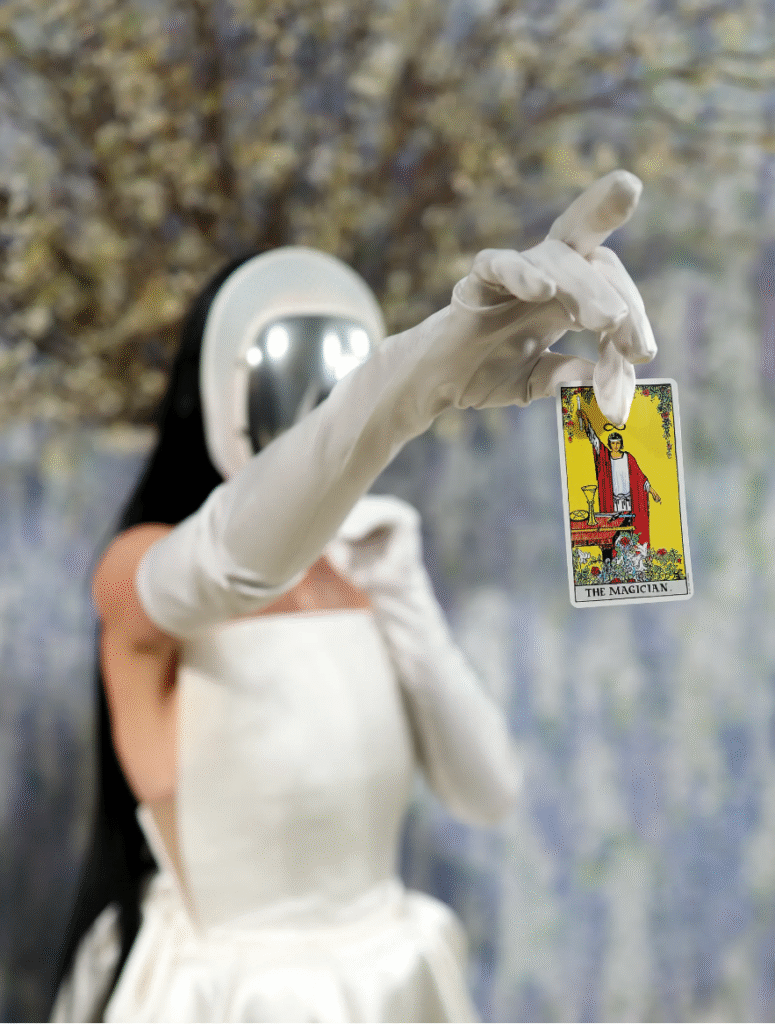
Perry carried a tarot deck on the red carpet and played tarot readings with reporters on the steps. The mask of a fencing helmet, the mystery of tarot cards, the purity of white satin—these elements were stacked together, creating an oversaturated system of symbols.
Tarot and fencing each have their own lineage in art history. Leonora Carrington and Irving Penn depicted tarot readers; Émile-Antoine Bayard depicted a female swordsman in her 1884 painting “The Duel.” Perry was clearly studying these references, or perhaps her styling team was. The result: she placed herself within a collage of art history, becoming a living, moving, and speaking installation.
But this stacking also brings risks. When there are too many symbols, they begin to cancel each other out. The philosophy of the mask, the fate of the tarot, the confrontation of fencing, the ghost of AI—these narrative threads vie for attention on the same body. Perry’s solution is: let them all exist, and let the viewer choose which one to focus on.
VI. From Chandeliers to Masks: Perry’s Met Gala Evolution
Looking back at Perry’s Met Gala history, tonight’s look is a logical continuation. In 2019, she wore a chandelier gown designed by Jeremy Scott; that same year, she changed into a hamburger outfit for the after-party. In 2017, as co-chair, she wore a red coat by John Galliano. In 2016, she challenged the boundaries of red carpet makeup with blue mascara, bleached eyebrows, and matte charcoal lips.
Perry told Vogue, “Last time I came to the Met Gala, I wore a cheeseburger. I thought, tonight I’m going to play a completely different hand. I feel like I’m embracing that lovely darkness.”
“Lovely darkness”—this phrase captures the heart of Perry’s aesthetic. Her looks have never been elegant, never “pretty.” They’re dramatic, a little absurd, with a certain self-deprecation. Tonight’s mask is the latest embodiment of this “lovely darkness”: it’s both threatening and harmless, both mysterious and playful.
VII. Echoes from Space
Perry’s mask has sparked a wide range of space-related associations—astronaut helmets, alien creatures, the return of E.T. This is no coincidence. Last year, Perry participated in Blue Origin’s space launch, experiencing weightlessness with Gayle King and Lauren Sánchez Bezos. Tonight, at the after-party, these three “space travelers” reunited.
The mask thus acquires another layer of meaning: it’s not just about concealment and reflection, but also about transcendence. On leaving Earth, leaving the body, leaving the need to be recognized. In space, no one can see your face. On the red carpet, Perry seemed to be saying: perhaps the same is true.
VIII. The Face Behind the Mask
Sometime that evening, Perry removed the mask. Before the photographers, she briefly revealed her face—a smile, a row of grills—before the mask closed again.
This moment is important. It reminds us: masks can be removed, faces can be restored. But in that veiled moment, Perry created a different mode of existence—not as Katy Perry, but as some anonymous, reflective, indefinable entity.
Fashion critics would say it was an “on-theme” look—”fashion is art,” and Perry transformed herself into a work of art. But a more accurate description might be: she transformed herself into a statement about art. About seeing and being seen, about reality and fabrication, about the vulnerability of the body in the digital age.
The white Stella McCartney gown was changed into another Stella McCartney crystal tulle gown for the after-party. The mask was removed, the tarot cards put away. Perry returned to her usual, visible, and recognizable self.
But that moment with the mask—that moment of anonymity on the steps, under the flashing lights, in front of millions—will remain in some form. Not as a memory of a dress, but as a memory of a question: What are we really showing when we cover our faces?